Label transparency
What SynoGut Does Not Publish, and Why It Matters
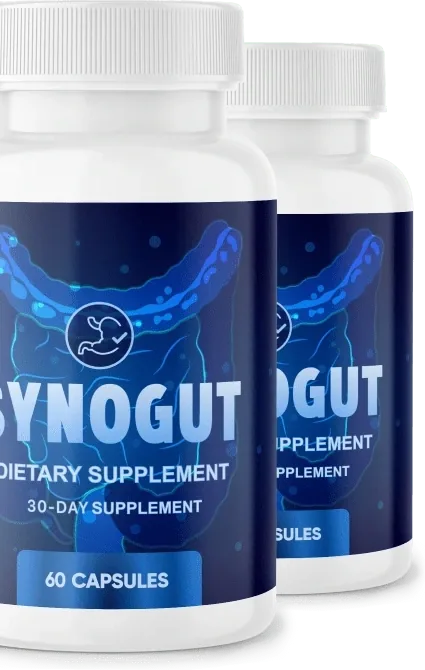
SynoGut publishes six ingredient names, 60 capsules a bottle labeled a 30-day supplement, three pack sizes, sales page wording and contact details. It does not publish a Supplement Facts panel, a serving size, any ingredient amount, plant parts, other ingredients, the capsule material, the gluten status of the oat, prices, verified reviews or any lab result. This site prints every one of those as not published.
What does SynoGut not publish?
Almost every number a buyer would want. The Supplement Facts panel, the serving size, the servings per container, every ingredient amount, the plant parts, the other ingredients, the capsule material, the gluten status of the oat, the prices, verified reviews and any lab result.
What is published is a list of six names and some sales copy. Here is the full inventory, and what each blank costs.
| What is missing | Where it normally lives | What the blank costs you |
|---|---|---|
| Supplement Facts panel | The back label of every US supplement bottle | There is no single place to read serving size, amounts and other ingredients |
| Serving size | The first line of that panel | You cannot confirm how many capsules the label counts as one serving |
| Servings per container | Under the serving size line | The 60 capsules on the front cannot be split into servings |
| Amount of each named ingredient | Beside each name inside the panel | No amount can be set against what any published source used |
| Plant parts | Inside the ingredient line, as husk, seed, hull or flesh | Husk and seed are different materials, and so is a whole fruit |
| Other ingredients | Under the panel, after the ingredient list | Binders and fillers cannot be checked by anyone avoiding one |
| Capsule material | Named in the other ingredients line | Vegetarians and vegans cannot tell what the shell is made from |
| Gluten status of the oat | Beside a gluten free claim, when a product carries one | Anyone avoiding gluten is left without an answer |
| Pack prices | On a pricing page | You only see the figure once you reach the checkout page |
| Verified customer reviews | A review section tied to real orders | There is no buyer experience to weigh, good or bad |
| Third-party lab results | A certificate of analysis matched to your lot | Nothing independent confirms the contents of a capsule |
What is published about SynoGut?
Four things, and it is a short list. The six ingredient names, the form and pack sizes, the sales page wording, and how to reach a person about an order.
Six ingredient names
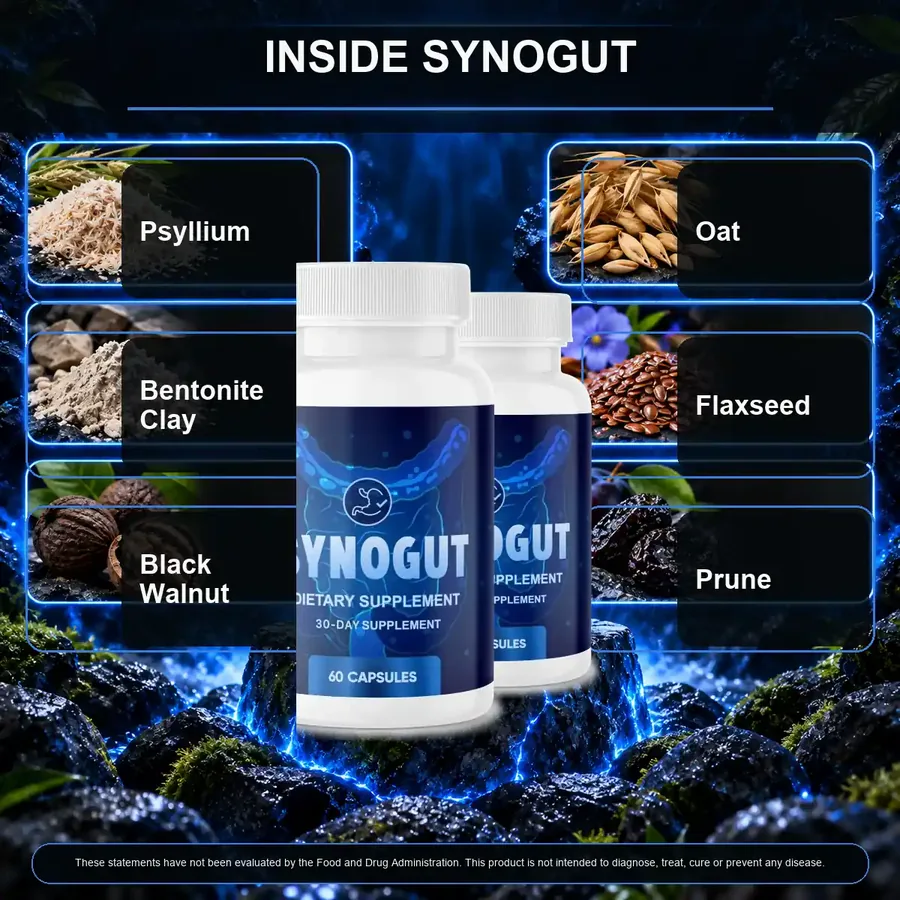
Psyllium, bentonite clay, black walnut, oat, flaxseed and prune, given in that order and nothing more.
The form and the packs
Sixty capsules a bottle, labeled a 30-day supplement, in packs of one, three and six.
Sales page wording
Lines such as "Support the health of your digestive system with 100% natural ingredients", which are sales copy rather than results.
Contact and terms
An order desk on +1 (302) 200-3480, a website inbox, a return address and a 60-day money-back window.
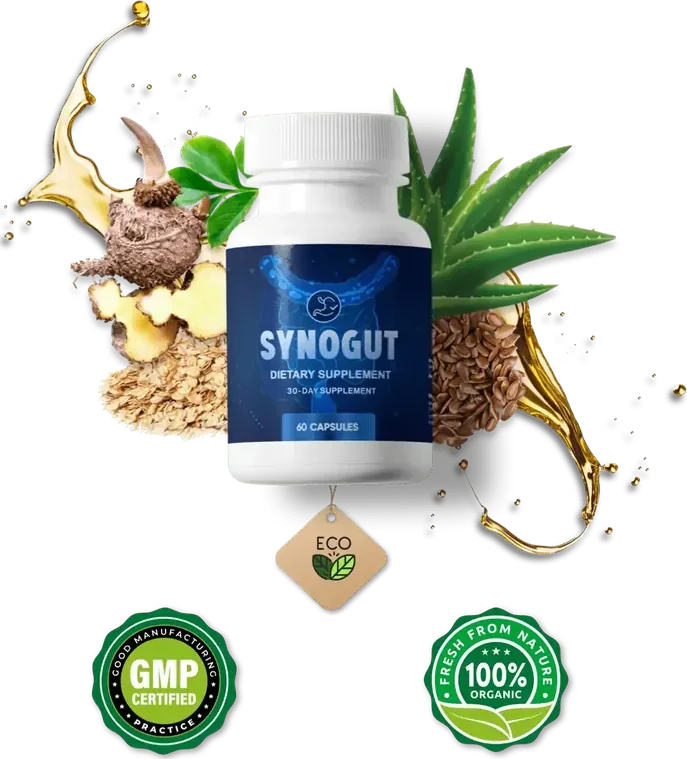
That is the whole of it. The sales page gives its six names in order, but never says the order reflects weight, so even the sequence cannot be read as information. The ingredients page takes each name in turn and the label page shows what exists beside what is missing.
Why do the missing amounts matter most?
Because an amount is the unit every useful comparison runs on. Without one, a name on a list is a word rather than a measurement.
- An amount is what lets you compare one bottle with another on the shelf.
- An amount is what a pharmacist needs to judge a medicine interaction properly.
- An amount is what connects a capsule to anything published about an ingredient.
- An amount is what tells you whether a name is a real share or a sprinkle.
Take the clearest example on this list. A review of four trials found that prunes helped stool frequency and consistency, using about 100 g of prunes a day for 3 weeks (Lever and colleagues, 2014). That is a real published figure about a real food. It cannot be carried across to this product, because nobody has published how much prune is in a capsule, or what the label counts as one serving.
The same problem repeats down the list. MedlinePlus describes how psyllium is normally taken and how far it should sit from certain medicines (MedlinePlus), but nothing here says how much psyllium a capsule holds. That is not a small gap. It is the gap.
Why are there no reviews or lab results here?
Because neither exists in a form we can stand behind. The source pack we were given did carry star scores, order counts and quoted review lines, and it described all of them as layout copy.
Layout copy is placeholder text used while a page is being designed. Publishing it as real customer feedback would be dishonest, so this site prints no star rating, no order count, no percentage and no review quote at all. The reviews page explains that decision instead of showing a score.
Lab results are the same story in a different suit. Lot SYN-26/SY-3292 and reference SYN-3292-26-SY are labels from our own product listing, not a certificate from a laboratory. No certificate of analysis was published for this product, so none is shown. The testing and quality page says what the seals on the sales page do and do not mean.
How does this site handle the blanks?
By leaving them blank and saying so every single time. Five rules cover the whole approach.
We write a blank as a blank
Every missing item is printed as "not published" rather than filled in with something that looks like an answer.
We never estimate an amount
No milligram figure appears anywhere on this site, because none was ever given to us for this product.
We do not print the source pack's numbers
The star scores, order counts and review lines in that pack are layout copy, so they stay out of every page.
We keep the lot references in their place
Lot SYN-26/SY-3292 and reference SYN-3292-26-SY come from our own product listing. They are not laboratory proof of anything.
We point you to the bottle and the desk
Directions come from the label you hold. Order questions go to a person on the phone, not to a web form.
Dietary supplements are not reviewed by the FDA for effect before they go on sale (FDA). The NIH Office of Dietary Supplements asks shoppers to know what is in a product, watch for interactions with medicine, and tell every clinician about everything they take (NIH ODS). The first of those three is the one this product makes difficult, and that is worth knowing before you spend money.
What can you do about the gaps?
Three things, and all of them are practical. Ask, read your own bottle, and keep a clinician in the loop.
Ask before you order. The order desk on +1 (302) 200-3480 takes questions about the product, the packs and the guarantee. Ask about the serving size, the capsule material and the grade of the clay. A seller who can answer is telling you something, and so is one who cannot.
Read the bottle you receive. If a panel is printed on it, that panel is the real document, and it beats anything on any website. Follow its directions. If it carries none, call before taking anything.
Keep a clinician in the loop. Black walnut is a tree nut, so a nut allergy in the household rules this product out. And a digestive change that lasts, pain in the abdomen, blood in the toilet or unplanned weight loss are all reasons to see a doctor rather than to try a capsule. Take your dates and your medicine list to that visit.
For the practical routine around any fiber product, read the post on water and medicine timing. For a walk through the ingredient list itself, read the post on the six names.
Questions people ask about this
Why is there no Supplement Facts panel on this site?
None was supplied. There is no back-label photo and no typed panel in the material we were given, so nothing is printed in its place.
How many SynoGut capsules should I take a day?
No serving size is published. The front label works out to two a day at 60 capsules for 30 days, but follow the directions on your own bottle.
Does a missing panel mean the product is unsafe?
No. It means you cannot check what is inside before you buy, and cannot show a clinician an amount. That is a gap in information, not a finding about the product.
Is there a certificate of analysis for SynoGut?
No. The lot and CoA references on this site come from our product listing, not from a laboratory, and no certificate was published.
Why does this site show no star rating?
The scores, order counts and review lines in our source pack are layout copy, which is placeholder text. Publishing them as real feedback would be dishonest.
Where can I see the price?
Prices are not published here. Packs come in one, three and six bottles, and the checkout page shows the current offer and any bonus.
What should I ask the seller before ordering?
The serving size, the servings per container, the capsule material, whether the oat is certified gluten free, and what grade of clay is used.
Sources for this page
- Lever E, Cole J, Scott SM, Emery PW, Whelan K. Systematic review: the effect of prunes on gastrointestinal function. Aliment Pharmacol Ther, 2014. Source
- MedlinePlus. Psyllium. U.S. National Library of Medicine. Source
- U.S. Food and Drug Administration. Dietary Supplements. Source
- NIH Office of Dietary Supplements. Dietary Supplements: What You Need to Know. Source
Keep reading
Ready when you are
Order SynoGut from the authorized US retailer
Capsules taken with water. Follow the label on your bottle. 60-day money-back guarantee. A real person at +1 (302) 200-3480 for orders, tracking and refunds.