Reading the ingredient list
The Six Named SynoGut Ingredients, Explained
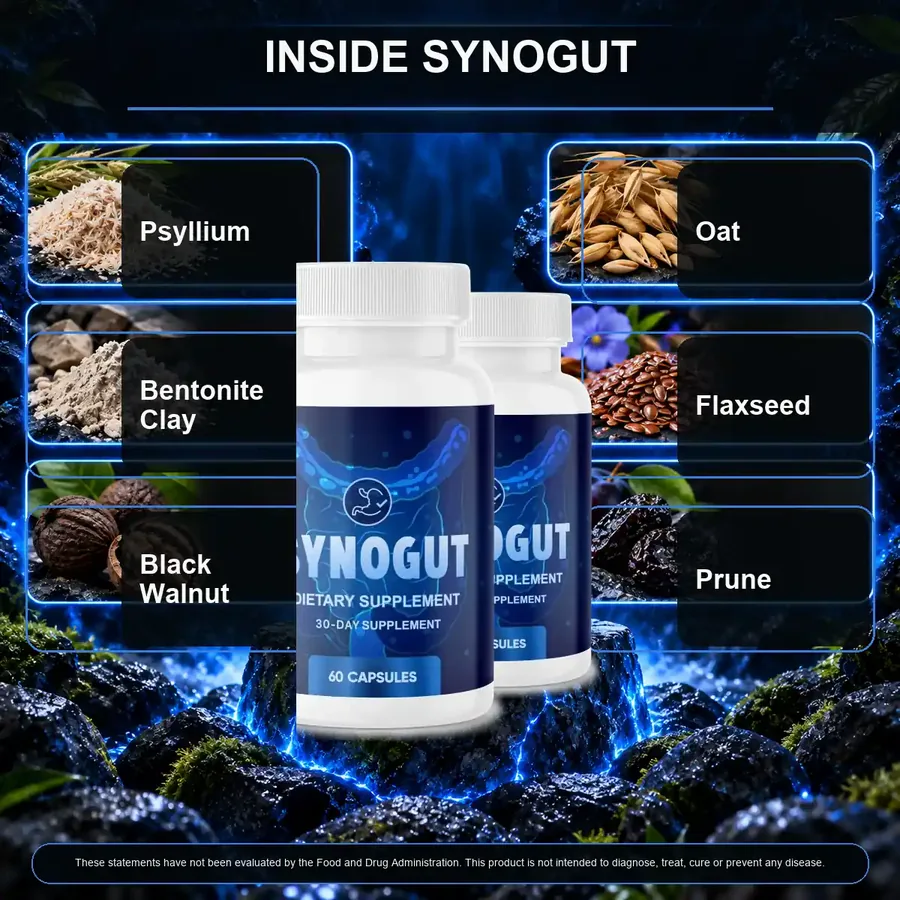
The SynoGut sales page names six ingredients in order: psyllium, bentonite clay, black walnut, oat, flaxseed and prune. Psyllium and flaxseed are soluble fibers that swell with water. Oat and prune are foods. Bentonite clay is a mineral material, not a fiber. Black walnut is a tree nut and a major allergen. No amount was published for any of the six.
What are the six named SynoGut ingredients?
Psyllium, bentonite clay, black walnut, oat, flaxseed and prune, in that order. Four of the six are fibers or foods, one is a mineral clay, and one is a tree nut.
No amount was published for any of them. That is the single most important thing to know before reading the rest of this post.
| # | Name on the sales page | What it is | Amount published |
|---|---|---|---|
| 1 | Psyllium | Husk of Plantago ovata, a soluble fiber that swells with water | Not published |
| 2 | Bentonite Clay | A mineral clay dug from the ground, not a fiber and not a food | Not published |
| 3 | Black Walnut | Juglans nigra, a tree nut and a major food allergen | Not published |
| 4 | Oat | Avena sativa, a cereal grain that carries its own fiber | Not published |
| 5 | Flaxseed | Linum usitatissimum, a seed with a sticky soluble fiber | Not published |
| 6 | Prune | Dried plum, the whole food most people already know | Not published |
The order above is the order the sales page gives. It is not stated to be an order of weight, so nothing about which ingredient dominates a capsule can be read from it.
Psyllium and flaxseed: the two that swell
Both are soluble fibers that take up water. That is what puts them in a fiber capsule, and it is also what makes the glass of liquid beside it matter.
Psyllium
Sold on pharmacy shelves as a bulk-forming product. MedlinePlus describes taking it with a full 8 oz glass of liquid.
Flaxseed
A seed whose fiber turns sticky in water. NCCIH notes that larger amounts may cause a bloated feeling or loose stools.
MedlinePlus lists psyllium as a bulk-forming laxative, describes taking it with a full 8 oz glass of liquid, and describes keeping it about 3 hours apart from certain medicines, naming digoxin, aspirin-type salicylates and nitrofurantoin among them (MedlinePlus).
NCCIH covers flaxseed and notes that larger amounts may cause a bloated feeling or loose stools, and advises asking your doctor if you take any medicine (NCCIH, 2025). Those two points travel together for both ingredients: liquid, and space away from your pills. The post on water and timing works through a normal day.
Oat and prune: two foods you already know
Oat is a cereal grain and prune is a dried plum. Neither is an exotic extract, and both are already sold in every supermarket in the country.
- Oat is a cereal grain, eaten by most households already, and it carries fiber of its own.
- Prune is dried plum, a whole food with a long history in kitchens rather than in laboratories.
- Both are foods first. Their place in a capsule is a smaller version of what a plate already does.
- Neither one turns a capsule into a meal, and neither replaces the plant food in your day.
Prune has the clearest research record of the six, and it is research about the food. A review of four trials found that prunes helped stool frequency and consistency, using about 100 g of prunes a day for 3 weeks (Lever and colleagues, 2014). That figure describes a bowl of fruit in a study, not a capsule, and nothing in it can be carried across to this product because no prune amount was published here.
Oat brings one open question with it. Oats are often grown and handled alongside wheat, so a gluten free claim depends on how they were kept apart (FDA). The sales page does not say whether this oat is certified gluten free, so anyone avoiding gluten should count that as unanswered.
Bentonite clay: the one that is not a fiber
Bentonite clay is a mineral material dug from the ground. It is not a fiber, not a food and not a nutrient with a daily value, which makes it the odd name on the list.
- Bentonite clay is not a fiber, so it does not belong in the fiber column at all.
- It is not standardized, so one product's clay tells you nothing about another's.
- It has no published amount here, so its share of a capsule cannot be checked.
- It is not covered by any test result for this product, because none was published.
Clay products are not standardized, and the FDA has warned consumers about high lead levels found in some bentonite clay products (FDA). That warning is about clay products in general. No test result of any kind was published for SynoGut, so nothing here is a finding about what is or is not in these capsules.
It is a reasonable thing to ask a seller about. Call the order desk on +1 (302) 200-3480 and ask what grade of clay is used and whether it has been tested, before you order rather than after. The fiber guide covers the same ground in more detail.
Black walnut: the name to check before anything else
Black walnut is a tree nut. Tree nuts are one of the major food allergens under US labeling law (FDA), and that makes this the first line to read on the whole list.
This is not a caution that can be managed with a smaller serving or a careful start. If a nut allergy is in the household, this product is not the one. The safety page and the who it is for page both say the same thing in their own words.
What does the list of six not tell you?
Almost everything a buyer would want to check. Six names is the beginning of a label, not a label.
No amount beside any name
Six names are given in order. No milligram figure appears beside any of them, and no total is given for the six together.
No plant part for most names
Husk, seed, hull, groat and flesh are different materials. Only psyllium is commonly sold as a named part, and the sales page does not specify.
No order of weight stated
US panels normally list ingredients by weight. The sales page gives an order but never says it reflects weight.
No serving size printed for us
The front label says 60 capsules for 30 days, but no name here can be scaled to a milligram a day.
No other ingredients and no capsule material
The binders, fillers and the capsule shell are all unpublished, which matters for anyone avoiding a specific material.
Directions come from the bottle you receive, because no serving size was published. If your bottle carries none, call the order desk before you take anything. The label page shows exactly what exists, and the post on what is not published lists every blank.
One last point, and it is the one that matters most. A capsule is not an answer to a symptom. A digestive change that lasts, pain in your abdomen, blood in the toilet or weight you did not plan to lose all belong in front of a doctor who can examine you. Take dates and your full medicine list to that visit.
Questions people ask about this
How much psyllium is in SynoGut?
Not published. The sales page names psyllium first but gives no amount for it, and no Supplement Facts panel was supplied.
Is black walnut safe for someone with a nut allergy?
No. Black walnut is a tree nut, and tree nuts are a major food allergen under US labeling law. Anyone with a nut allergy should not take this product.
Is bentonite clay a fiber?
No. It is a mineral material from the ground. It is not standardized across products, and the FDA has warned consumers about high lead levels in some clay products.
Does the order of the six names mean anything?
Not necessarily. US panels usually list by weight, but the sales page never says its order reflects weight, so nothing can be read from the sequence.
Is the oat in SynoGut gluten free?
Not published. Oats can pick up gluten unless they are grown and handled to keep it out, and the sales page does not say whether this oat is certified.
Do prunes in a capsule work like prunes on a plate?
There is no way to tell here. The prune research describes about 100 g of the fruit a day for 3 weeks, and this product publishes no prune amount at all.
Sources for this page
- MedlinePlus. Psyllium. U.S. National Library of Medicine. Source
- National Center for Complementary and Integrative Health. Flaxseed and Flaxseed Oil: Usefulness and Safety. Updated February 2025. Source
- Lever E, Cole J, Scott SM, Emery PW, Whelan K. Systematic review: the effect of prunes on gastrointestinal function. Aliment Pharmacol Ther, 2014. Source
- U.S. Food and Drug Administration. FDA warns consumers about lead in a bentonite clay product. Source
- U.S. Food and Drug Administration. Food Allergies. Source
- U.S. Food and Drug Administration. Gluten and Food Labeling. Source
Keep reading
Ready when you are
Order SynoGut from the authorized US retailer
Capsules taken with water. Follow the label on your bottle. 60-day money-back guarantee. A real person at +1 (302) 200-3480 for orders, tracking and refunds.