Ingredients
SynoGut Ingredients List: 6 Questions to Ask About Every Name
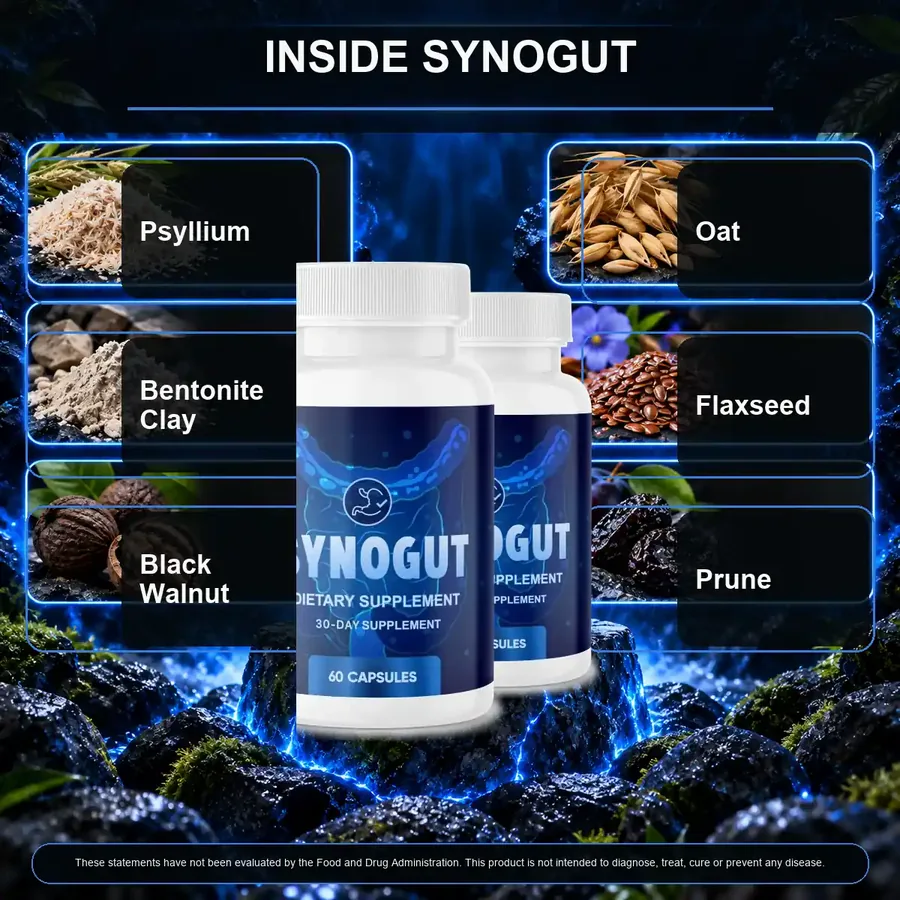
The sales page names six SynoGut ingredients: psyllium, bentonite clay, black walnut, oat, flaxseed and prune. No amount, plant part or capsule material is published for any of them. Ask six questions of every name, then check your bottle's own label, which may print more than the sales page.
Key facts
- Six ingredients are named, in this order: psyllium, bentonite clay, black walnut, oat, flaxseed, prune.
- Amount, plant part and form: not published for any of the six.
- Other ingredients and capsule material: not published.
- Black walnut is a tree nut. Nothing says the oat is certified gluten free.
- No probiotic strain, enzyme or extra herb is named in the published list.
What are the ingredients in SynoGut?
The ingredient panel on the sales page lists six items, and the order is fixed. Psyllium comes first, then bentonite clay, black walnut, oat, flaxseed and prune. Four are fibers or foods, one is a clay and one is a tree nut.
The sales page does not say the order reflects weight, so the sequence is not a clue to amounts. It also gives no plant parts, no forms such as husk or powder, and no list of other ingredients.
This post does not walk the six one at a time, which our existing ingredient posts already do. It gives you a set of questions that works on any label, then applies them to SynoGut as a grid.
What are the 6 questions for every ingredient?
Question 1: What exactly is it?
Husk or seed, hull or nut, whole fruit or powder. The part changes how an ingredient behaves.
Question 2: How much is in a serving?
A weight beside the name is what lets you compare a bottle with research or with another product.
Question 3: What do public sources say?
Look for a federal health page or a published review, and check whether it used a weighed amount.
Question 4: Is it an allergen or a gluten risk?
Tree nuts are a major allergen. Grains may pick up gluten on the way to the bottle.
Question 5: Could it change how my medicine works?
Some fibers change how much medicine the body takes up, so timing matters.
Question 6: What would make me say no?
Decide your deal-breakers before you read the answers. A nut allergy is a deal-breaker for most people who have one.
How do the six names score on those questions?
Here is the whole grid in one place. A dash means the sales page is silent.
| Ingredient | Part or form | Amount | Allergen or gluten flag | Medicine note |
|---|---|---|---|---|
| Psyllium | Not published | Not published | None noted in the sources | Keep about 3 hours from some medicines |
| Bentonite clay | Not published | Not published | None noted. FDA lead warning on some clay products | Ask about testing |
| Black walnut | Not published | Not published | Tree nut, a major allergen | None noted |
| Oat | Not published | Not published | May carry gluten unless certified | None noted |
| Flaxseed | Not published | Not published | None noted | Ask your doctor if you take any medicine |
| Prune | Not published | Not published | None noted | None noted |
The first two columns are identical, and that is the story. Every row has a name, and no row has the facts that would let you weigh it.
Which ingredients need a second look?
Three of the six carry a flag that is easy to miss on a quick read.
Black walnut is the first. Tree nuts are one of the major food allergens under US labeling law (FDA). Because no amount is published, you cannot argue the amount is small. For anyone with a nut allergy this is a firm no.
Oat is the second. It has no gluten of its own, but oats are often handled with wheat, so a gluten-free claim depends on how a crop was grown and processed (FDA). The listing shows a gluten-free seal and does not say the oat is certified.
Bentonite clay is the third. It is a clay, not a food, and clay products are not standardized. The FDA has warned that some clay products carried high lead levels (FDA). That is a note about the category, and it is why we suggest asking what testing exists.
What do public sources say about the other three?
Psyllium, flaxseed and prune have the plainest public notes, and all of them are about the ingredient on its own, not about this capsule.
- Psyllium is sold as a bulk-forming laxative. It is taken with a full 8 oz glass of liquid and kept about 3 hours from some medicines (MedlinePlus).
- Flaxseed in larger amounts may cause bloating or loose stools, and NCCIH says to ask your doctor if you take any medicine (NCCIH, 2025).
- Prune was reviewed across four trials, which found it helped stool frequency and consistency at about 100 g a day for 3 weeks (Lever and colleagues, 2014).
Read the last line again. That is a weighed portion of fruit eaten as food. It does not tell you what a capsule with an unpublished amount of prune does.
Why do some pages list different SynoGut ingredients?
You may see lists with extra items on other pages, such as herbs, a live-bacteria strain or a plant fiber not on our list. We follow the sales page, which names six, and we cannot confirm anything beyond it.
If a page lists more than six, ask which label or sales page it read. An old version, a different product or a keyword-stuffed guess are all possible. The label on your own bottle is the authority, and it can only add to what we know.
What should you ask the seller about the ingredients?
Four questions will close most of the gaps. Ask them before you order and write down the answers.
- What is the serving size, and what weight of each ingredient does it hold?
- Which parts are used: psyllium husk or seed, black walnut hull or nut?
- What are the other ingredients and what is the capsule made of?
- Is the oat certified gluten free, and what testing exists for the clay?
A seller who can answer is telling you something. A seller who cannot is telling you something too.
Frequently asked questions
What are the ingredients in SynoGut?
The sales page names six: psyllium, bentonite clay, black walnut, oat, flaxseed and prune. No amount, plant part or other ingredient is published.
How much of each ingredient is in a capsule?
Not published for any of the six. No Supplement Facts panel was supplied, and the list order is not stated to mean weight.
Does SynoGut contain nuts?
Yes. Black walnut is a named ingredient and a tree nut, so anyone with a nut allergy should not take it.
Is SynoGut gluten free?
Not published. The listing shows a gluten-free seal, but it does not say whether the oat is certified.
What is the capsule made of?
Not published. Capsule material and other ingredients are unknown from the material we hold, so check your bottle.
Does SynoGut contain a probiotic?
None is named in the published list of six. If your bottle prints a different list, follow the bottle.
Our view
We like lists that fit on one screen, and this one does. Our concern is the missing second column. A name without an amount is a promise to be filled in later.
Use the six questions on SynoGut and on anything else you are comparing. SynoGut is a dietary supplement and not FDA approved, as no supplement is. Take allergy and medicine questions to a doctor or pharmacist.
Sources for this post
- MedlinePlus. Psyllium. U.S. National Library of Medicine. Source
- National Center for Complementary and Integrative Health. Flaxseed and Flaxseed Oil: Usefulness and Safety. Updated February 2025. Source
- Lever E, Cole J, Scott SM, Emery PW, Whelan K. Systematic review: the effect of prunes on gastrointestinal function. Aliment Pharmacol Ther, 2014. Source
- U.S. Food and Drug Administration. FDA warns consumers about lead in a bentonite clay product. Source
- U.S. Food and Drug Administration. Food Allergies. Source
- U.S. Food and Drug Administration. Gluten and Food Labeling. Source
Read next
Ready when you are
Look at the packs and terms
If the ingredient list suits you and the gaps do not bother you, the order page shows packs and the 60-day terms before payment.
Synogutdaily earns a commission when a reader buys through an order link on this site. Your price stays the same.